I study how humans remember and represent information, and how computational models can help explain these processes.
My research so far has combined behavioral experiments, computational modeling, and machine learning to investigate human memory, visual attention, and linguistic representations. Beyond these questions, I am interested in the broader relationship between human cognition and artificial intelligence: whether AI systems can develop meaningful representations of intent, what it means for a language model to reason rather than merely produce convincing responses, and how insights from human learning and cognition might help us build more capable and generalizable intelligent systems.
M.S. by Research, IIIT Hyderabad Machine Learning Engineer, Adobe
prajplays://terminaltype ‘help’
type `help`, or `experiment` to test your memory
praj:~ $ whoami
Prajneya Kumar. I study why some things stick in memory, and I build things on the side.
praj:~ $ ls
research/ memory, gaze, language
publications/ papers and posters
lab/ things I build
about/ the longer version
This terminal works. Try experiment for a one-minute memory test, or help.
Research interests
My interests lie at the intersection of human cognition and artificial intelligence. Some emerge from questions I’ve investigated experimentally; others are directions I hope to explore through computational and cognitive approaches.
01
How do we acquire, represent, and remember knowledge?
Why are certain experiences, words, or concepts easier to remember than others? How do the structure of our representations, prior knowledge, and experience influence what we learn and retain? And what can these patterns tell us about how knowledge is organized in the mind?
What does it mean for an AI system to understand or act with intention?
When a language model produces a coherent explanation, follows a goal, or appears to reason about another person’s beliefs, what does that reveal about its underlying representations? Can we meaningfully study intentionality in artificial systems, and how might we distinguish genuine representational capabilities from behavior that merely resembles them?
Prospective research direction
03
Can studying human cognition help us build better reasoning systems?
Humans learn from limited experience, draw on prior knowledge, and apply what they know to unfamiliar situations. Which cognitive principles contribute to these abilities? Could insights from human learning, abstraction, and reasoning inform how we design, train, or evaluate language models and other AI systems?
Prospective research direction
04
Where do human and artificial intelligence converge, and where do they differ?
When computational models reproduce patterns of human attention, memory, or reasoning, how much can we infer about the processes behind those behaviors? What can systematic differences between human and machine performance reveal about their representations, learning mechanisms, and ability to generalize?
Prospective extension: Human–AI reasoning and generalization
Selected research
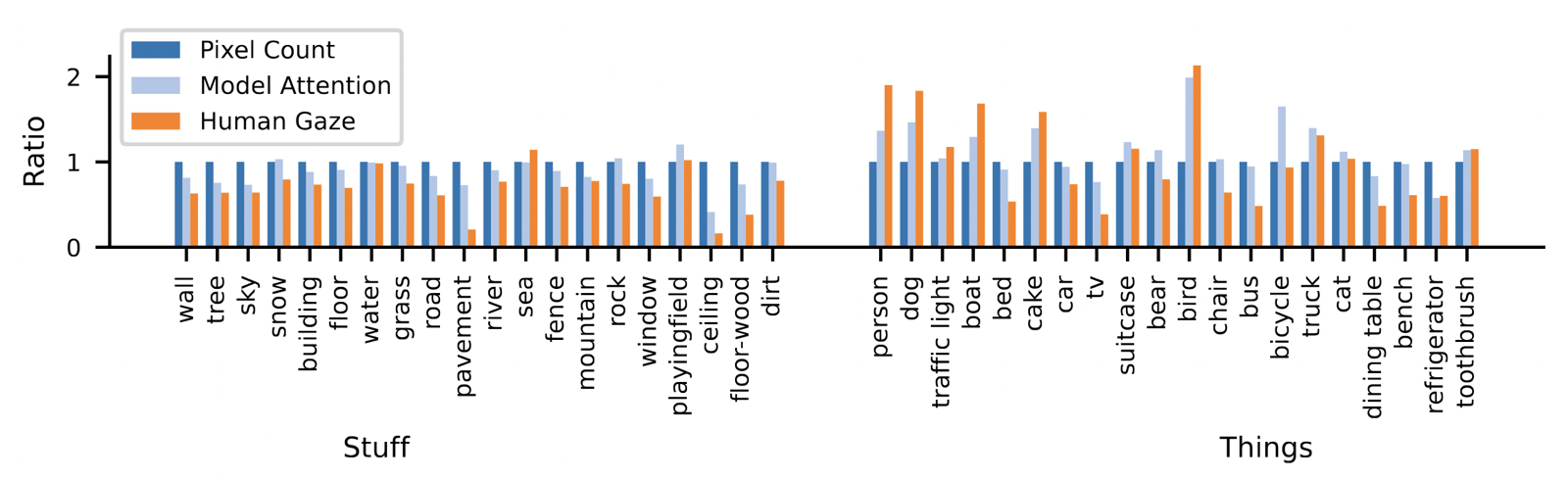
Model attention (light blue) and human gaze (orange) relative to how much of the frame each class occupies (dark blue). Both favor things over stuff. From Kumar, Khandelwal et al., WACV 2025.
I investigated whether a model trained to predict video memorability learns spatiotemporal attention patterns that resemble human gaze, combining computational modeling with human eye-tracking data.
I am investigating whether word memorability generalizes across English and Hindi, combining a large online memory experiment with analyses of semantic networks built from word embeddings.
Outside research I make music, play chess, and post short videos about technology, human behavior, and culture on Instagram as @prajplays. I also build things in the Lab, mostly to see whether an idea works once it leaves my head.