Peer-reviewed, WACV 2025
Seeing Eye to AI: Comparing Human Gaze and Model Attention in Video Memorability
Prajneya Kumar*, Eshika Khandelwal*, Makarand Tapaswi, and Vishnu Sreekumar
PaperPDFSupplementary materialarXivProject pageCodeTalk video
Research question
When a machine learning model is trained to predict how memorable a video is, does it learn to attend to the same visual information as humans?
Approach
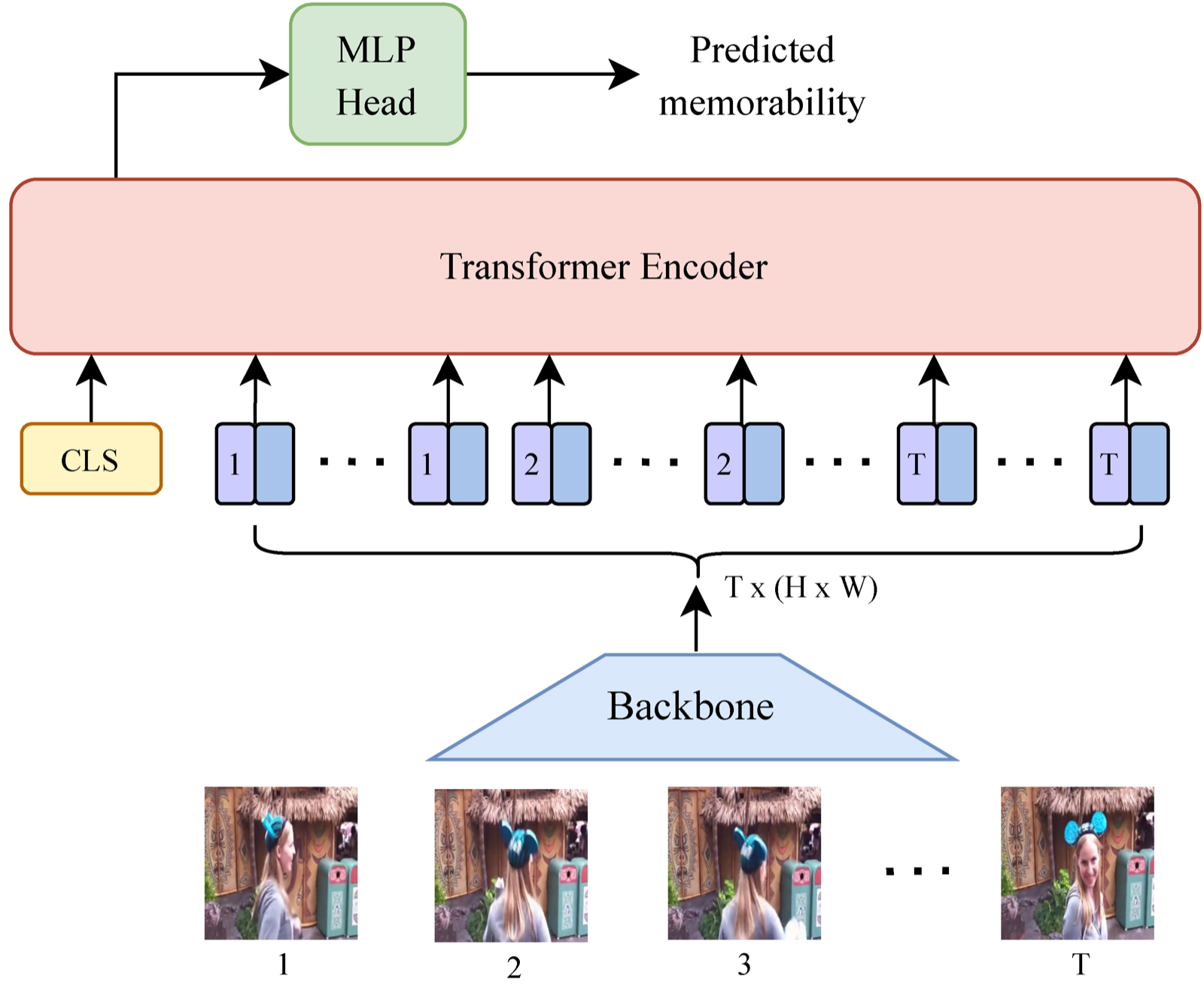
We developed a CNN–Transformer architecture for video memorability prediction. Each frame passes through an image backbone, such as a CLIP-pretrained ResNet-50; the resulting spatio-temporal features go to a Transformer encoder, and an MLP on the CLS token predicts the memorability score. The CLS token’s self-attention weights give a readout of where and when the model attends.
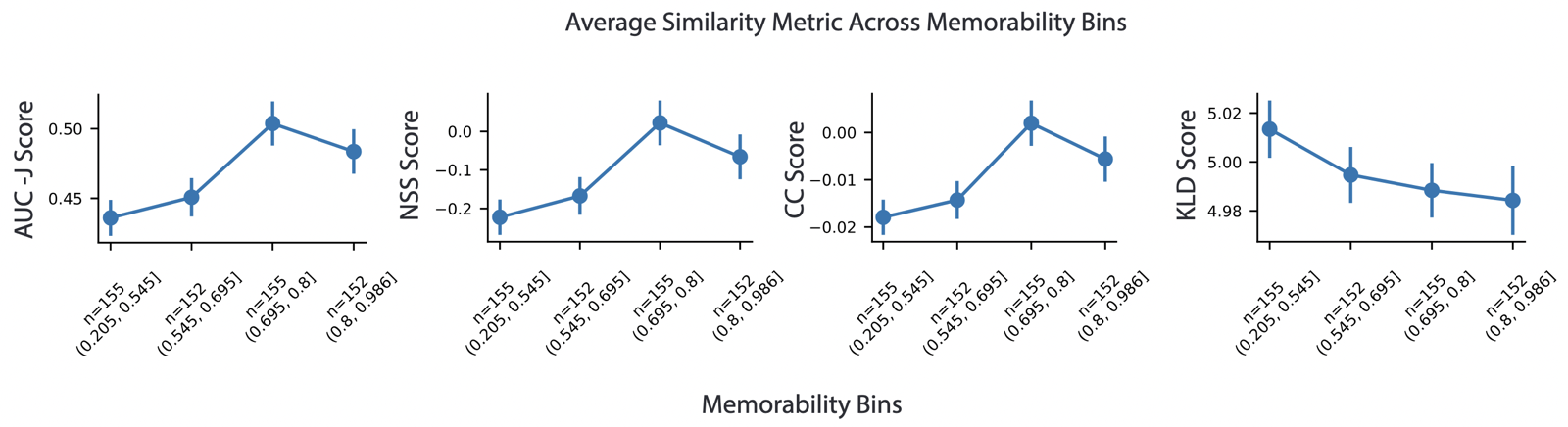
We compared the model’s attention with human gaze recorded during a video recognition-memory task. Twenty participants watched 140 unique videos from each of Memento10k and VideoMem while binocular gaze was recorded with an SR Research EyeLink 1000 Plus at 500 Hz, and pressed a key when they recognized a repeated video. We compared fixation density maps and model attention maps with AUC-Judd, NSS, CC, and KL divergence, using split-half human agreement as a ceiling and shuffled videos as a chance baseline. Panoptic segmentation let us ask how attention was distributed across semantic categories.
Key findings
- A model trained only to predict a memorability score showed spatial attention patterns similar to human gaze, especially for more memorable videos.
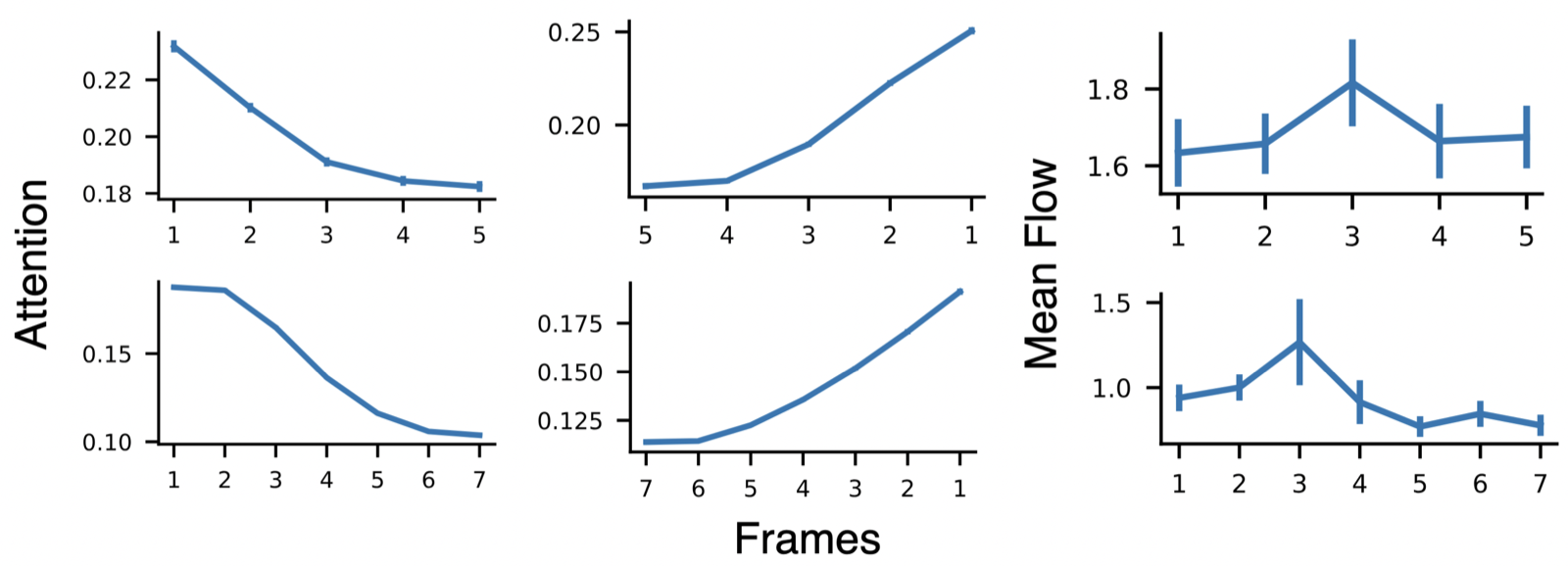
- The model gave more attention to the initial frames of a video, with no temporal bias built into the architecture. Human fixations were also more consistent across people in early frames than in later ones.
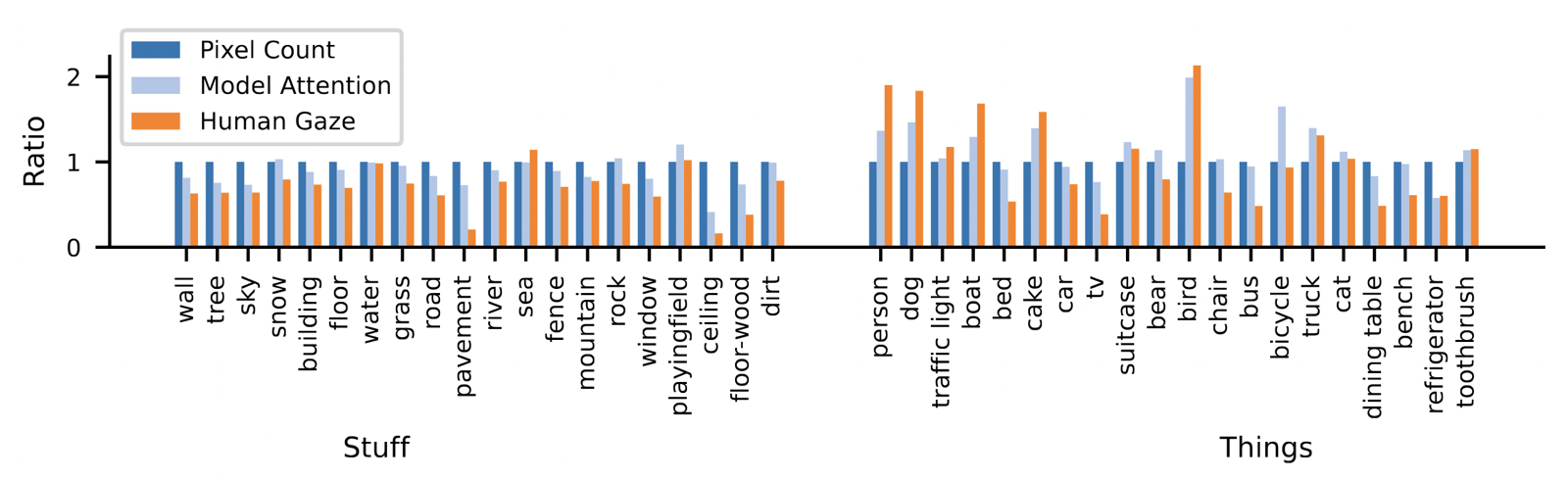
- Both the model and human observers gave a larger share of attention to things (well-defined objects such as people or cars) and a smaller share to stuff (background regions such as sky or road) than their occurrence in the frames would predict.
Why it matters
Predicting human memory is not necessarily equivalent to explaining it. By comparing model attention with behavioral measurements, this work asks whether a predictive model recovers meaningful regularities in human visual processing, rather than only reporting prediction accuracy.
The paper also notes limits: existing video memorability datasets have data-leakage issues, and larger, more diverse data are needed to test how well these patterns generalize.
Citation
Kumar, P.*, Khandelwal, E.*, Tapaswi, M., & Sreekumar, V. (2025). Seeing Eye to AI: Comparing Human Gaze and Model Attention in Video Memorability. In Proceedings of the IEEE/CVF Winter Conference on Applications of Computer Vision (WACV), pp. 2082–2091.
@InProceedings{Kumar_2025_WACV,
    author    = {Kumar, Prajneya and Khandelwal, Eshika and Tapaswi, Makarand and Sreekumar, Vishnu},
    title     = {Seeing Eye to AI: Comparing Human Gaze and Model Attention in Video Memorability},
    booktitle = {Proceedings of the Winter Conference on Applications of Computer Vision (WACV)},
    month     = {February},
    year      = {2025},
    pages     = {2082-2091}
}